
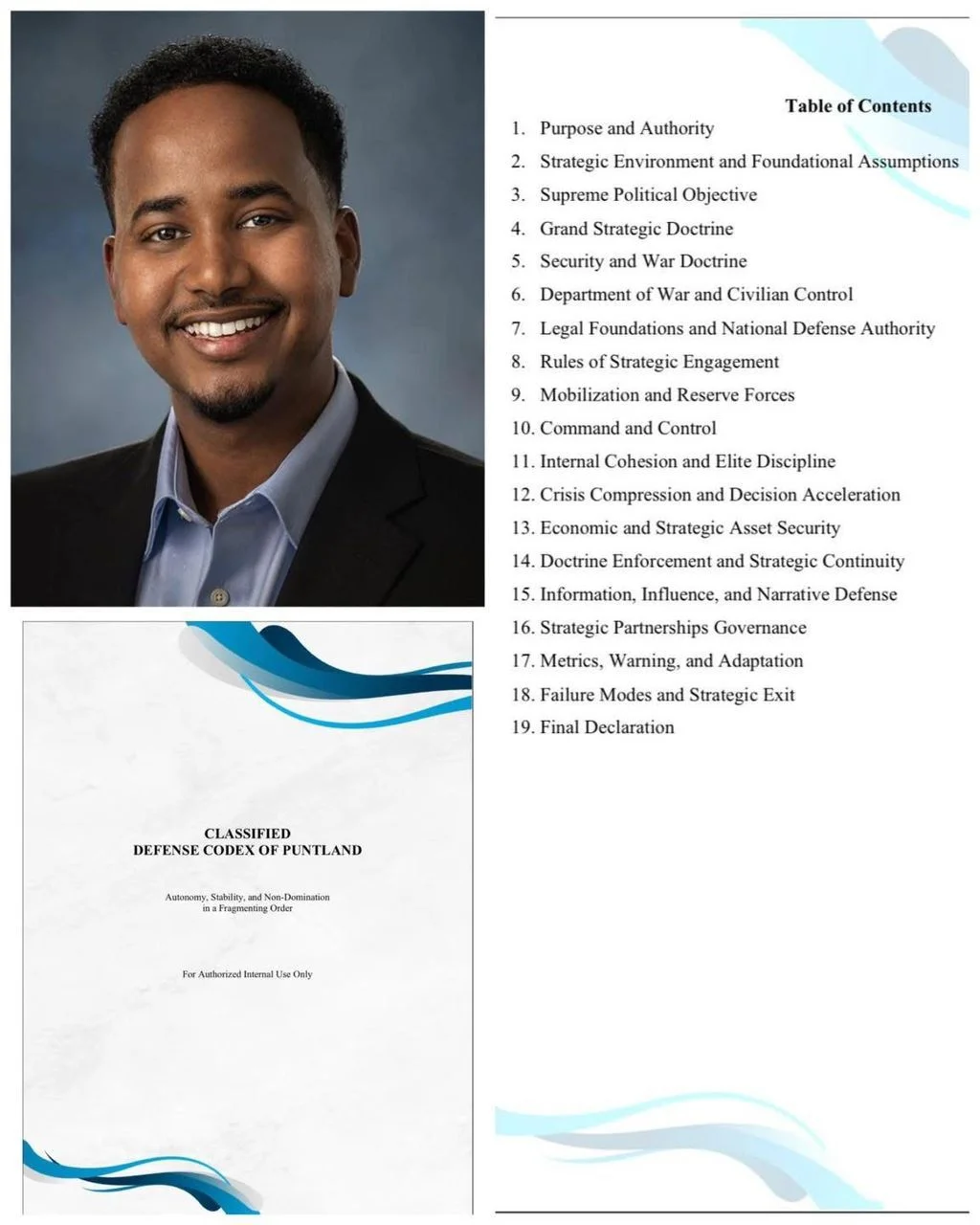
Puntland’s Strategic Middle Path
Puntland stands at a defining moment in its political trajectory. Across the Somali political landscape, two powerful currents are reshaping the future: an assertive push toward centralization from Muqdisho, and a parallel rise in separatist ambitions driven by the logic of recognition and fragmentation. While these paths appear to offer opposing visions, they share a common consequence for Puntland. They both risk constraining its ability to determine its own
political destiny.
What is required, therefore, is not alignment with either trajectory, but the articulation of a disciplined and coherent alternative. An unclassified adaptation of the Puntland First Defense Codex provides such a framework, one that places autonomy, stability, and non-domination at the center of Puntland’s long-term strategy.
At its core, this framework begins with a simple but demanding principle: the preservation of decision-making autonomy. Puntland’s primary objective is not expansion, ideological victory, or symbolic recognition. It is the protection of its ability to choose its own future freely, deliberately, and without coercion. This objective imposes discipline. It requires that every political, economic, and security decision be evaluated not by its immediate benefit, but by its long-term impact on Puntland’s freedom of action.
In this context, the dominant political framing of Somalia’s future as a binary choice, centralization or separation, is strategically misleading. Centralization, particularly when pursued through unilateral constitutional changes and institutional consolidation, risks subordinating Puntland’s security, fiscal systems, and governance structures to external control. Separatism, when pursued prematurely or without sufficient institutional preparation, risks isolation, internal fragmentation, and dependence on uncertain external recognition.
Both paths reduce flexibility. Both invite pressure. Both, ultimately, weaken Puntland’s position.
The alternative lies in a structured middle path: the pursuit of confederation as a defensive political architecture. Confederation offers a way to formalize autonomy while preserving cooperation. It anchors legitimacy in consent rather than imposition and prevents the concentration of power in a single political center. Importantly, it is not treated as a guaranteed outcome, but as a strategic instrument. It preserves stability while allowing political conditions to evolve.
This approach requires a fundamental shift in how security is understood. Within the Puntland First framework, the role of force is not to wage war, but to prevent coercion. Security institutions exist to ensure that Puntland is never forced into submission, fragmentation, or conflict on unfavorable terms. This demands a posture built on preparedness, discipline, and control. The use of force must remain limited, deliberate, and tied to clear political objectives. It cannot become a tool for signaling, recognition-seeking, or compensating for political weakness.
Equally critical is the preservation of internal cohesion. The greatest threat to Puntland’s autonomy is not external pressure alone, but internal fragmentation that invites external influence. When political competition spills into institutional breakdown, when security forces become politicized, or when public narratives reinforce rival centers of power, the foundations of autonomy begin to erode. Cohesion, therefore, is not a matter of unity for its own sake. It is a strategic necessity.
Economic sovereignty forms another pillar of this framework. In the contemporary environment, control over ports, revenue systems, and trade corridors carries as much strategic weight as military capability. Economic arrangements that transfer control, create dependency, or concentrate influence in external hands must be approached with caution. Diversification, oversight, and retention of fiscal authority are essential to preserving long-term autonomy. Economic coercion, in this sense, must be treated as equivalent to political or military pressure. External partnerships, while necessary, must also be carefully governed. Puntland cannot afford to become dependent on any single external actor. Partnerships must remain non exclusive, reversible, and fully subordinate to Puntland’s own command and institutional control. The purpose of engagement is to strengthen autonomy, not to outsource it.
Perhaps the most important feature of this strategic approach is its emphasis on restraint. In moments of crisis, when pressures intensify and timelines compress, the temptation to make rapid, irreversible decisions grows stronger. Yet it is precisely in these moments that discipline matters most. Strategic patience, controlled escalation, and the avoidance of premature commitments preserve the very asset Puntland seeks to protect, its ability to choose.
At the same time, this framework does not ignore the possibility that confederation may fail to materialize. Should sustained coercion or structural exclusion make such an arrangement unattainable, Puntland must be prepared to pursue alternative outcomes, including sovereign statehood. This preparation, however, must be institutional rather than rhetorical. It requires the quiet development of governance capacity, fiscal independence, and unified authority. These are the conditions that give any future decision credibility and sustainability.
Ultimately, the question facing Puntland is not whether it will align with centralism or separatism. It is whether it can maintain the discipline to avoid being forced into either. Strategy, in this sense, is not about declaring a destination. It is about preserving the ability to decide when and how to move.In an era defined by shifting alliances, transactional politics, and increasing coercion, survival belongs not to those who react the fastest, but to those who remain the most controlled. Puntland’s strength will not come from rhetoric or alignment, but from the quiet consolidation of its institutions, the discipline of its leadership, and the clarity of its long-term vision.
The path forward is neither loud nor immediate. It is deliberate.
And it begins with a simple commitment: to protect, above all else, the freedom to choose